

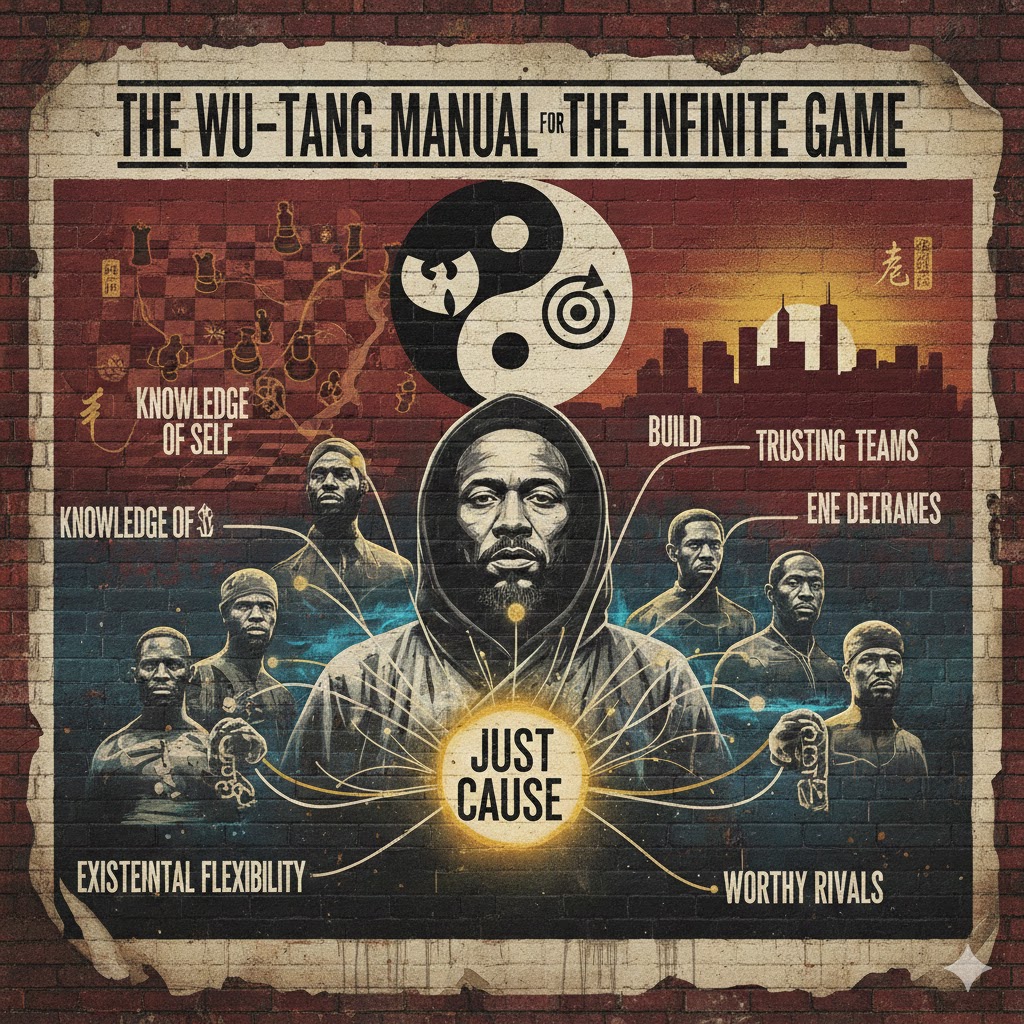
Simon Sinek‘s concept of the Infinite Game—playing to stay in the game, focusing on a Just Cause over short-term wins—finds a compelling, real-world analog in the foundational philosophy of RZA and the Wu-Tang Clan. What Sinek outlines as a business strategy, RZA built as a survival mechanism and a blueprint for cultural and economic longevity.
The synergy between the two is striking, as the core practices Sinek advocates for an infinite mindset are deeply embedded in the “Five-Percenter” and martial arts-inspired principles that forged the Wu-Tang empire.
The Just Cause: Knowledge of Self is the Mission
Sinek defines a Just Cause as a vision so appealing people are willing to make sacrifices to advance it. For Wu-Tang, this cause transcends mere record sales; it is about Knowledge of Self and the collective upliftment of the community.
- RZA’s Just Cause: The core Wu-Tang philosophy, heavily influenced by the Five-Percent Nation (Nation of Gods and Earths), is centered on the pursuit of KNOWLEDGE, WISDOM, and UNDERSTANDING—the Supreme Mathematics and Alphabet. This pursuit is an endless, infinite mission to “Build” and elevate themselves and their people out of poverty and mental slavery. This is their higher purpose, greater than any individual album sale or beef.
- The Infinite Mindset: The focus is on advancing a vision (self-mastery and cultural empowerment) rather than just beating a rival. Wu-Tang’s initial, unprecedented deal structure—allowing individual members to sign solo contracts with other labels—was an act of Existential Flexibility (another Sinek principle) in service of the Just Cause of collective economic freedom and saturation of the market. They sacrificed traditional industry structure for long-term power.
Building Trusting Teams: The Clan’s Structure
Sinek emphasizes the need for Trusting Teams—a circle of safety where vulnerability is accepted. RZA’s leadership, though dictatorial in the early days (a necessary finite step to establish an infinite foundation), was built on unwavering mutual trust.
- RZA as the “Abbot” and Visionary: RZA, as the sonic architect and “Abbot” of the Clan, demanded a five-year dictatorship. The members’ willingness to place their careers entirely in his hands was the ultimate expression of trust. They believed in his Courage to Lead (Sinek’s final principle) and the shared vision he presented.
- The Nine Chambers: The structure of the nine-man Clan (often referred to as the Nine Chambers) functions as a resilient, interconnected organization. If one member struggles or leaves, the structure itself, the Wu-Tang Brand, endures. The collective is greater than the sum of its parts—the definition of a team built for the Infinite Game.
Worthy Rivals and Existential Flexibility: The Shaolin Way
The ability to adapt and learn from adversaries and changing circumstances—Worthy Rivals and Existential Flexibility—is the final bridge.
- Worthy Rivals: The concept of the Worthy Rival is personified in the competitive, yet fraternal, dynamic between the members themselves (e.g., Method Man vs. Raekwon on a track) and their conscious engagement with other rap crews. Their competitive nature pushes them to improve, just as Sinek suggests a worthy rival can make a company better, not simply defeated.
- Existential Flexibility: Wu-Tang’s entire aesthetic—a syncretism of Eastern philosophy, martial arts cinema, comic books, and Five-Percenter ideology—was a radical pivot from the dominant rap narratives of the time. This willingness to make a fundamental disruption to the business model (their unique album deal) and the creative direction (their sound) to advance the Just Cause is the essence of Sinek’s concept. They didn’t stick to a rigid “plan”; they adapted their strategy to serve their fixed purpose.
In conclusion, the Wu-Tang Clan didn’t set out to “win” the rap game in a finite sense; they sought to change the game and keep playing for generations. RZA’s philosophy provided the Just Cause and the Courage to Lead, creating a Trusting Team with the Existential Flexibility to outlast competitors—a perfect, street-level execution of Sinek’s Infinite Mindset.